Computational Electrodynamics Project
This was my final project for ECE 4350 Electromagnetic Applications. It is a report explaining the fundamentals of numerical methods used for analysis of electromagnetic propagation. In this report I simulate an example waveguide using the open source FDTD (Finite Difference Time Domain) simulator MEEP.
Afterwards I provide a detailed mathematical explanation about the stability of spacial discretization techniques. To accomplish this, I analyze the stability of the simulated system using a digital linear state space approximation of the physical system and analyze the positions of the poles in the Z plane.
Code for the visualizations can be found here.
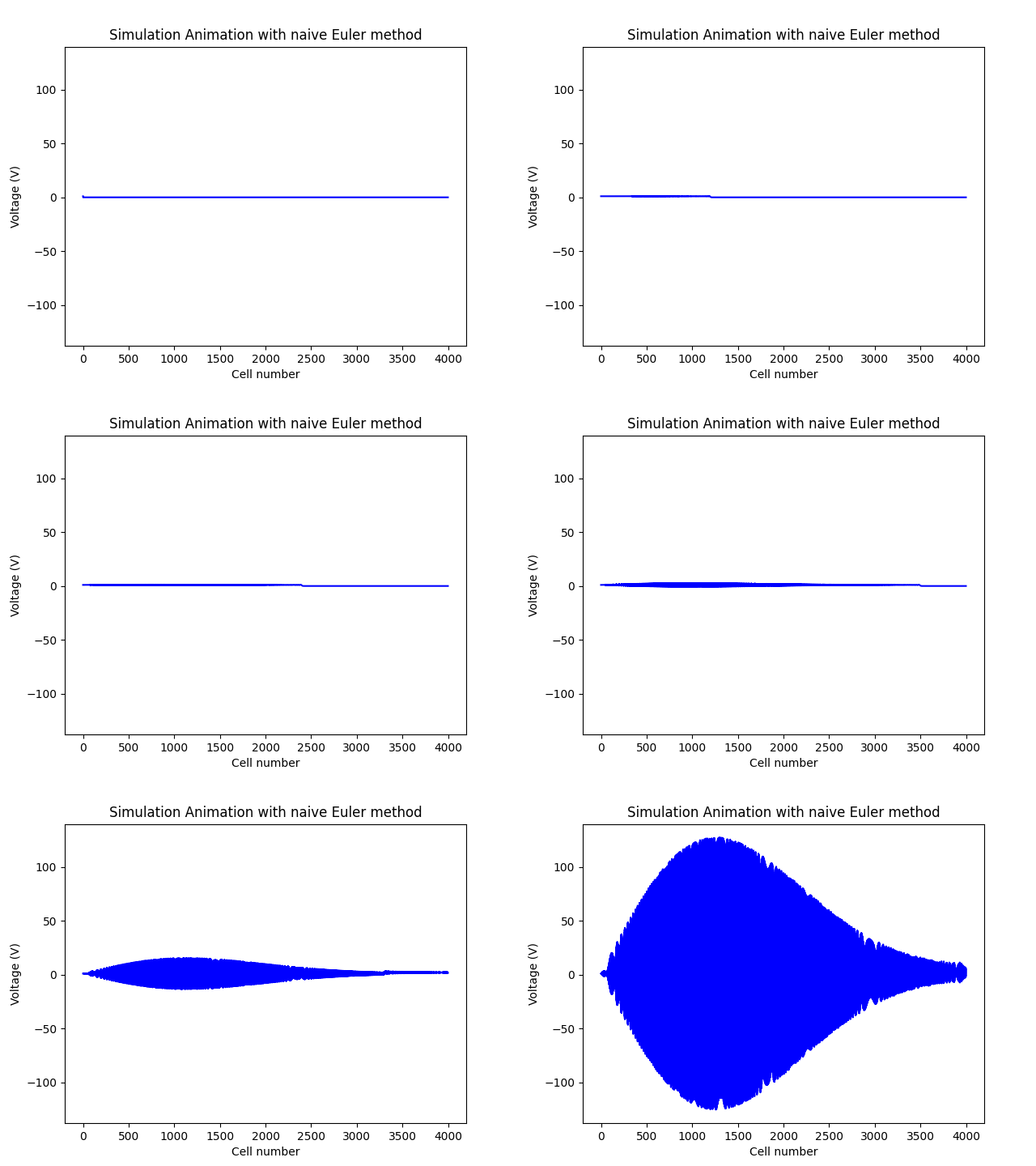
FDTD with naive (unstable) discretization
This animation shows how the simple discretization approach leads to instability in the simulation.
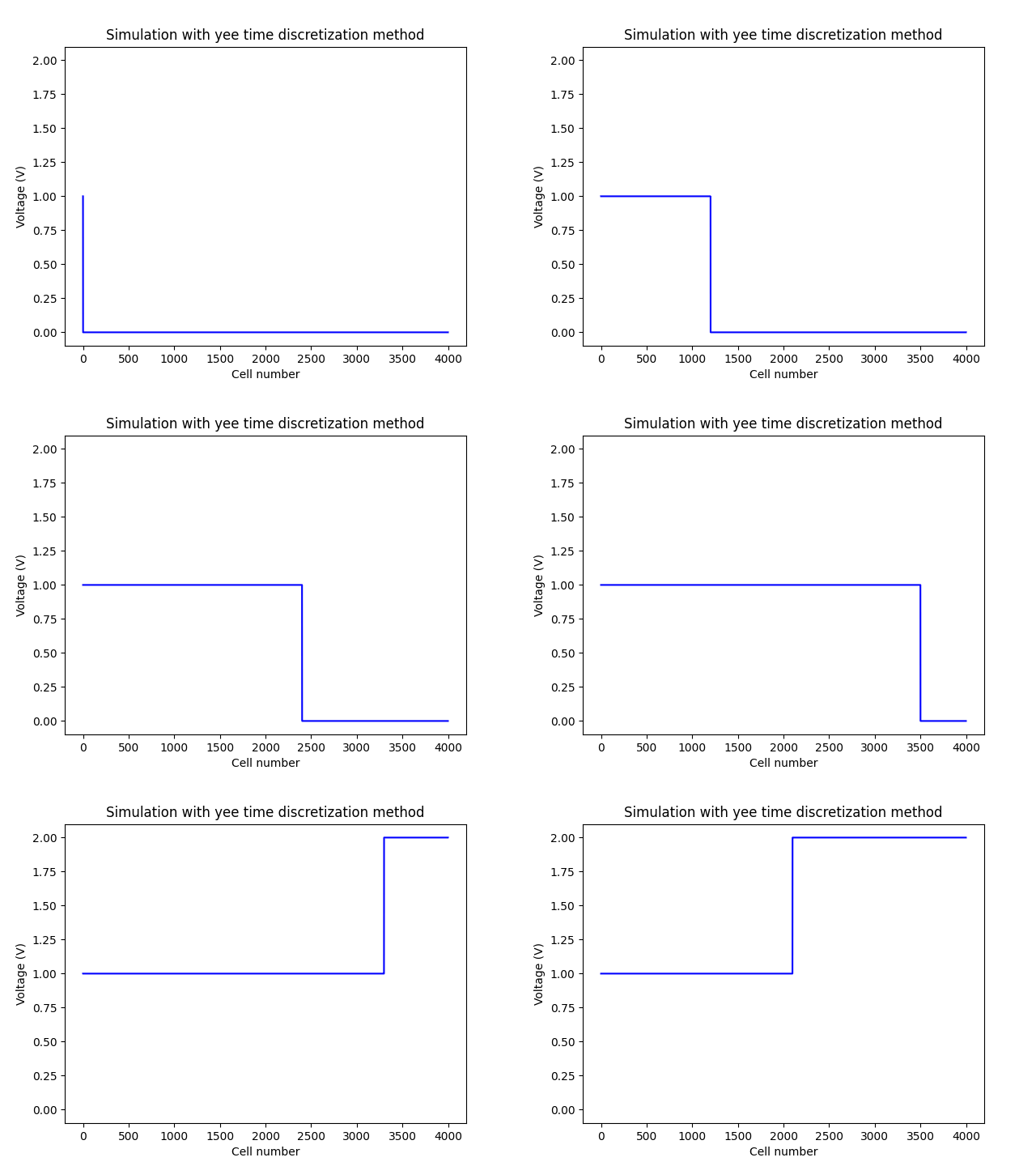
FDTD with Yee discretization
This animation shows how the Yee approach leads to a stable system.
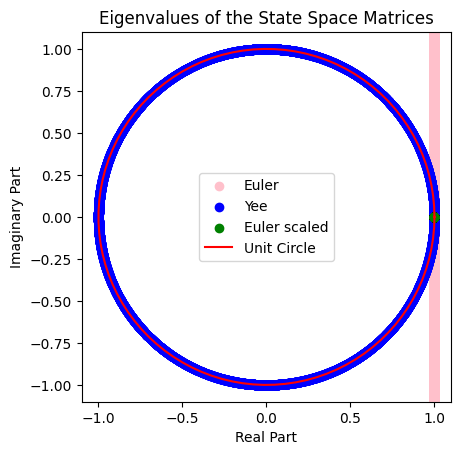
Pole locations for naive and Yee discretization
The pole placements show us that the standard discretization has poles outside the unit circle making it unstable. In contrast, the Yee discretization has poles on the unit circle, indicating a marginally stable system.
3. Project Report PDF
An excerpt from my project report where I show why some numerical methods are stable and some are unstable.